Sunday, 4 August 2013

Qualifying for the 2013 Hungarian Grand Prix in photos.


                                      Jenson Button off to the weighbridge after going out in Q2.


       Lewis emerges from his car having scored a surprise pole position.  Alonso qualified fifth.


                                                                      The top three.

                                                       
                                                               A relaxed Felipe Massa


                                                      Christian Horner off to have dinner.


                                                                 Jean Eric Vergne

Third practice session for the 2013 Hungarian Grand Prix in photos.


The McLaren of Sergio Perez is rescued after a meeting with the wall in the final practice session.

 
                       The Williams team race to get the car back to the garage from the weighbridge.


                      As do the Red Bull team, ensuring they are keeping to the 80km/h speed limit!


                                                                   Esteban Gutierrez 


Alonso fans


Friday, 2 August 2013

2013 Hungarian Grand Prix: Friday Practice in photos.

Going to F1 practice.  The best school trip ever?


A quick refresh in the pits for Alonso before another run.


Mark Webber visits the scrutineers.

Sebastian Vettel is wheeled back into his pit garage.


              Stilt walkers use water sprayers to keep fans cool.


                                                                      Kimi on track.


                     Niki Lauda out on the town in Budapest.  In deep conversation with Ross Brawn.


                                                        Jean Todt in the same restaurant.


Thursday, 1 August 2013

Why a commitment to racing in Hungary until 2021 is an excellent move by Bernie.

Monaco without the walls: A phrase often used to describe the Hungaroring due to its twisty nature and lack of overtaking opportunities. The circuit provides drivers with a complex technical challenge due to the high number of corners in comparison with the length of the circuit. Fourteen corners on a track with the third slowest lap of the year and the shortest bar Monaco makes it difficult, because drivers aren't given the safety of multiple long straights to rest. Renowned for being a track where passing opportunities are like gold dust, and therefore a good qualifying session is priceless, the number of wins scored from pole position is surprisingly low. Thirteen wins from pole in twenty eight races. In the last nine years, the ability to turn pole into victory has belonged solely to Lewis Hamilton. Turning a magnificent pole into a magnificent win last weekend was a carbon copy of the result obtained last year, and of his win in 2007 following his inherited pole position from team mate Fernando Alonso, after the Spaniard was accused of impeding him during qualifying. In the years scattered amongst Hamilton's triumphant pole to chequered flag victories, the Hungaroring has thrown up some unexpected results.


Lewis Hamilton turned two consecutive pole positions into perfect victories in 2012 and 2013.

The dominance of Sebastian Vettel in 2011 bypassed Hungary as he was unable to convert his pole position into a win. Rain fell just before the race causing a slippery start; one made on intermediate tyres. On lap five, Vettel went wide gifting the lead to Lewis Hamilton, then as the track started to dry, Button made one of his astute tyre decisions, choosing an early move to slicks to move him above Vettel, tucked up behind his team mate. A second brave tyre decision by Button, this time to stay out after a brief shower, put him in prime position to take the victory.

Jenson Button took the victory from Sebastian Vettel after making good tyre choices in mixed conditions.

Sebastian Vettel was also unable to take the win his qualifying lap had set him up so well for in 2010. A change to Mark Webber's strategy following an incident on track requiring a safety car, in addition to a penalty for Vettel for breaching the rules regarding distance kept from it, resulted in the German watching his team mate take the win in a season in which the two of them were vying for the title.

2010 podium.  Despite being polesitter, Vettel watches his team mate stand on the top step after the race.

Fernando Alonso put his Renault on pole for the 2009 race, but it wasn't a healthy race for the team as his car was carrying a fuel pump problem on top of issues with badly graining tyres. A lengthy pit stop obviously wasn't long enough as his exit from the pits revealed the front right wheel wasn't correctly attached. His efforts in hauling his stricken Renault round the track on three wheels to return to the pits were not rewarded as the following lap proved fatal with the earlier fuel pump problem ending his race which was won by Lewis Hamilton.

2008 saw Lewis Hamilton capture his second Budapest pole position and was the year of the duel for the championship between himself and Felipe Massa. The lead of the race was mostly contested between the two of them, until misfortune struck both, firstly Lewis with a punctured tyre followed by Massa with a failed engine, leaving second McLaren driver, Heikki Kovalainen to take the lead and the victory.

Kimi Raikkonen was polesitter for the 2006 Grand Prix but crashed after a battle with his second set of tyres, giving Alonso the lead, until a loose tyre meant Jenson Button inherited it to take his maiden Formula One victory. 2005 was the scene of a battle between pole sitter Michael Schumacher and Kimi Raikkonen who eventually overcame the German to triumph.

Although won from pole this year, the race was littered with interesting moments right from the start as Fernando Alonso used the same wizardry positioning we have seen at many races this season to move up the field on the first lap; this time taking fourth from Rosberg at Turn 2. After losing his place to one Ferrari, Nico made contact with the other, causing small parts of both cars to be sprayed across the track; action watched by following driver Kimi Raikkonen, who was just recovering from his own swift excursion onto the grass.

With Mark Webber leading the race following the first round of pit stops for the leaders, himself being on a different strategy, and those leaders rejoining the track behind Jenson Button, also in a different race, meant that we were treated to a great battle for fourth position. Nursing an overheating KERS system, Sebastian Vettel wasn't able to make an easy move on the McLaren, meaning we were treated to some feisty attacking from him, while being hunted by Romain Grosjean who was increasingly able to glimpse the scarlet of Alonso in his mirrors. The contest peaked on lap 24 with a great Vettel overtake on Button at turn 5, then like a domino effect as they streaked away from the corner, Grosjean and Alonso also took advantage.

Other good overtaking moves included one from Grosjean on Felipe Massa, although the Frenchman was later penalised for gaining advantage by leaving the track, and a subsequent Button move also on the Brazilian. Lewis Hamilton, running on newer tyres, was able to pull off a beautiful overtake round the outside of Mark Webber and on lap 51, passed the Australian again, this time on the inside of the hairpin. The end of the race wasn't void of entertainment as Vettel attempted to snatch second position from Kimi Raikkonen two laps from the chequered flag.

At a track known for its lack of overtaking opportunities, there are bound to be processional moments, but Hungary always balances these with ones full of excitement. One of the most celebrated overtaking moves in history is Nelson Piquet on Ayrton Senna at the inaugural Hungarian GP in 1986. Stalking him down the straight heading towards turn 1, the elder Brazilian drifted deftly around the outside of his younger countryman as if he was piloting a Star Wars land speeder.

Having secured its future on the calendar until 2021, Bernie Ecclestone has recognised the value the Hungaroring gives to racing in Europe. Hungary don't have a Formula One talent of their own to follow, but that doesn't dent their passion. They turn up to the race in vociferous droves. It is also a place visited by fans from all over Europe; very heavily populated by those from Finland, Kimi fans in particular, but also from Estonia, Spain, Britain, not to mention the host of Robert Kubica fans from Poland. The mix of different nationalities from all over the continent ensures that a wide range of drivers are supported, making the race, and atmosphere particularly special and unique. Changes in attendance that may be caused by the inclusion of a Russian Grand Prix are yet to be seen, but the large contingent of visiting Germans, despite having their own Grand Prix, would suggest it won't make a difference. The same elaborate costumes that appear every year are tangible evidence of the appetite and desire fans at the Hungaroring have, and of the consistent and committed support they give.


Often a hot race, the Hungarian GP is a place where passion for the sport matches the soaring temperatures, where fans from all over the continent join together at an impeccable venue to share their love for this sport. Well done Bernie, this was a decision well made.    

Wednesday, 24 July 2013

Daniel Ricciardo: The next Australian to achieve Formula One success.

There have been just a sprinkling of Australian drivers in Formula One, but from that sprinkling of just fourteen, four World Championships and thirty five wins have been achieved and celebrated with the most successful being Jack Brabham.  Commanding the wheel of a Cooper, Brabham enjoyed back to back World Championship success in 1959 and 1960.  At the end of the following year, Jack decided to leave Cooper and start up his own team.  Big changes loomed for the 1966 season with engine size increasing to 3 litres, a change Brabham had the foresight to prepare for, while other teams were not quite so organised.  He reaped the reward of his canniness, bringing the car home to win four races that year to clinch his third World Championship.  To this day he remains the only driver to have won a title in a car designed and manufactured by the man in the cockpit. 


Jack Brabham.  Photo: www.news.drive.com.au


Further Australian success was stalled until Alan Jones commandeered his Williams to World Championship victory in 1980.  With the FW07- Ford proving competitive in 1979, Jones took four wins, but despite taking more victories than Jody Schekter and Gilles Villeneuve, seven retirements meant he came only third in the Championship.  With better reliability the following year, Jones scored five victories in his FW 07B- Ford, taking the title ahead of Nelson Piquet.  Rivalry between himself and team mate Carlos Reutemann hindered Jones’s hopes of taking two consecutive championships as the Argentinean refused to obey team orders to let Jones past at the 1981 Brazilian Grand Prix. 

Alan Jones takes the title.  Photo: www.bbc.co.uk

Suffering similarly at the hands of a team mate for whom the words ‘team orders’ don’t feature in his vocabulary is Mark Webber.  The only other Australian driver to have won a Formula One race, Webber has driven for Red Bull since 2007.  Originally partner to David Coulthard, Mark was joined by Red Bull Junior Sebastian Vettel in 2009, who graduated to the senior team following the Scots retirement at the end of 2008.  Narrowly missing out on the title to Vettel in 2010, Webber has since had to endure number two status at the team, causing a fractious relationship between himself and Seb, that became unruly at this year’s Malaysian Grand Prix, when he, just as his countryman Alan Jones had twenty two years previously, watched his team mate ignore team orders to take the chequered flag in his place.  And just as his countryman did twenty two years previously, Mark Webber will retire at the end of the season. 

Jones and Webber talk on the grid.  Photo: www.zimbio.com

The announcement of the retirement of the third Australian to win a Grand prix paves the way for another to become the fourth.  Aussie born Daniel Ricciardo, currently in his second year at Toro Rosso, always knew this would be the year to prove himself worthy of a seat at the senior team for 2014, and since the news broke he has shone on track, especially in qualifying.   His performances were enough to earn him a half day outing in the Red Bull testing for Pirelli at the Young Driver’s test at Silverstone.   

Webber and Ricciardo.  Photo: www.foxsports.com.au

Daniel first tested for Red Bull Racing in December 2009.  Achieving the fastest time of the test overall, he subsequently became test and reserve driver for both Red Bull and Toro Rosso in 2010.  He was the only driver to represent the team at the young drivers test at the Yas Marinas circuit in Abu Dhabi where he put the previous week’s qualifying lap set by Sebastian Vettel in the shade by recording the overall fastest lap of the test.   Confirmation of his status as Toro Rosso test and reserve driver for 2011 together with FP1 appearances was his accolade.   Completing fifty nine laps at Silverstone last week, he was third fastest, and despite an excursion into the gravel seemed positive about his efforts,

“It was my mistake really.  I lost the rear on the entry and was just probably pushing a little bit too hard.” 

His reputable test sessions have so far met with reward regarding career progression; something he will be hoping continues in the form of a seat at the senior team.  Comments made by Christian Horner to Sky Sports add fuel to his hope,

“It’s a perfect opportunity for us to slot Daniel in to the car just to have a look at him as a part of our decision making process for Mark’s replacement.” “This test fell fortuitously for us to put him in the car and have a look.”   


He is clearly enjoying proving himself ready for a seat with Red Bull downplaying any possible pressure saying he is having fun.  His endless positivity is endearing and he will make a worthy replacement for Mark, both in terms of being his Red Bull successor, and his countryman.  If Red Bull make the decision to give credibility to their young driver programme and choose him over Kimi Raikkonen, he will have the opportunity to be the next Australian to truly achieve success in Formula One.  Daniel Ricciardo: Continuing to fly the flag for Australia.  

Monday, 15 July 2013

The Formula One Safety Car: Adding a touch of spice.

A yellow flag indicating the deployment of a safety car due to an incident on track will always induce different reactions in a watching audience.  Reactions largely dependent on allegiances to particular drivers and teams.  A moan if a preferred driver is storming out in the lead and the other runners are given a chance to catch up, juxtaposed by a cheer if the favourite is running further back and can capitalise on the pack being squeezed together.  Whatever reaction incited, a safety car equals drama and we have been treated to two successive races that have been brought alive with the emergence of the silver Mercedes SLS.  

Photo: www.commonswikimedia.org

The Marussia of Jules Bianchi navigating its way back onto the track after he had vacated it, triggered the safety car on lap twenty five of the German Grand Prix at the Nurburgring.  This employment will have met with cheers from Lotus fans as it allowed Romain Grosjean to cover leading driver Sebastian Vettel's pit stop, closing the gap between them. When it was time for the third tyre change, Lotus tried the undercut, however this was successfully shadowed by Red Bull meaning Vettel retained a closely fought lead.

Vettel fought hard to keep the Lotus' behind.  Photo: www.f1fanatic.co.uk

Kimi Raikkonen also benefited from the appearance of the silver arrow on track as it allowed him to reduce the ten second gap between himself and Lewis Hamilton, then hunt down his team mate who cordially let him past on lap 55 for second place.  The battle for the lead  between Kimi and Vettel got spicy and following the race the German admitted the intense fight towards the end proved difficult,

“It was a tough race; it was one of the toughest for a long time.  I'm happy the race wasn't two or three laps longer as Kimi was a bit quicker towards the end.”

Whether met with joy by Lotus fans or with tension by Vettel and Red Bull fans, the safety car created an interesting end to the race.  In the contest between hard fought battles that last to the bitter end versus a sole car streaking away to victory, the former will always triumph.

Lap 43 at Silverstone the previous week saw Bernd Maylander take his silver charge out on track, after the Red Bull of Sebastian Vettel was left stranded due to a gearbox failure.  Having bunched up the pack, the safety car returned to the pits, leaving things on track to become electrifying. Ricciardo's position is purse snatched by Hamilton and Alonso in tandem. Mark Webber storms up behind Kimi Raikkonen snatching his second place.  Next in his sights; leader Nico Rosberg.  A fierce battle between the two ensues.  Nico just holds off the dauntless challenge from the Australian to take the win. Meanwhile, Alonso whips past Raikkonen for the final podium place and Hamilton makes his way up to fourth as consolation for the tyre failure he suffered earlier in the race.  The action seen in the final laps following the safety car was sensational.

Mark Webber hunts down Nico Rosberg in the final stages of the British Grand Prix.  Photo: www.europeancarweb.com

Looking ahead to Hungary, the race there in 2010 springs to mind as one spiced up as a result of the safety car.  Losing his front wing due to contact with another driver, Vitantonio Liuzzi caused its deployment on lap fifteen.  The yellow flag acted as a green light for a flurry of pit stops for most of the front runners, with the exception of Mark Webber, who found himself leading the race as a result.  Consequently, Red Bull's strategy for the Australian was to put in as many stonking laps as possible on current tyres, in order to stretch out a lead on Fernando Alonso sizeable enough to gift himself a stop.  Initially devised to help him claim second position, the strategy turned into a race winner after his team mate, who had been leading, received a penalty for breaching rules about distance kept from the safety car.

Tweaking aspects of Formula One to make racing more exciting and appeal to growing audiences is a continual process.  The introduction of DRS and Pirelli tyres in 2011 increased the amount of overtaking opportunities by ultimately allowing drivers to get closer to each other.   While the idea of having a mandatory safety car appearance goes against its purpose and principle, it would have the same effect.  However, despite its nature in closing the pack and consequent ability to add sparkle to a race, it is the unpredictability of its appearances that also create drama.  Teams have to react quickly, ensuring the right call is made regarding when to make a pit stop; something Lotus didn't quite achieve with Kimi Raikkonen at Silverstone, but Red Bull did in Germany. 

While a guaranteed safety car trip at every race for its pilot Bernd Maylander is not appropriate, there is no question that when it is required, the racing becomes spine tingling, especially when the necessity arises in the closing stages of the race.  Something every race fan should cheer about.


Tuesday, 9 July 2013

The University of Hertfordshire embody the spirit of the Formula Student competition at the UK event at Silverstone.

Arriving at an unusually sun drenched Silverstone and being met by the sight of a sea of engineering students, industriously working to prepare their entrant for the Endurance event epitomised the principle of the Formula Student competition.   A platform to provide students with the practical skills needed to operate successfully in the workplace; a competition where, though Faculty Advisors are there to oversee, the entries are piloted by the students.  This event at Silverstone provides a stage for the showcase of their entries and completes the life cycle of their projects. There to meet Howard Ash from the University of Hertfordshire, Faculty Advisor of the most successful UK Formula Student team, I was treated to a valuable insight into the kinaesthetic, 'learn by doing' philosophy embodied by the competition, and in particular, UH Racing. 


The UH Racing team.

Minimum design requirements have to be conformed to, but largely the teams have free reign giving the students an avenue for creativity.  Creativity is a powerful learning tool providing scope for experimenting with new ideas, evaluating performance and adapting practice, therefore developing their skills.  Due to the liberty given around design, the cars vary greatly.  Freedom of choice means cars are entered powered by various fuel types, a variety of suspension and brake structures, while some dabble with aero packages.

Pushing the boundaries is inevitable in a competition like this.  Electric concept entrants are becoming  more powerful resulting in an advantage in this year’s competition.  Although there is freedom around design, rules are in place to keep things fair between all teams, providing another dimension to the student's learning.  Appetite for victory can result in teams taking risks in having their power right on the limit, meaning if they edge slightly over there is no room for correction; something that was seen at this year's event with a team's electric car being disqualified from the competition during scrutineering, for being slightly too powerful.   Harsh lessons are often the best as students learn that the statics are important and it is better to be safely within the regulations and continue in the competition, than push too hard for success in the dynamic events.  A good balance between preparations for both types of events is essential to be successful, as the effort put into powering the car for the dynamics is redundant if you can't get through scrutineering. 

The University of Hertfordshire's contender, the UH16, is powered by a 599cc Yamaha R6 motorcycle engine and a student designed and built multi point fuel injection system.  It features a pull and push rod actuated sprung suspension and their aero package creates valuable downforce.  UH Racing build on successes from previous entries, but in keeping with the ideology of the competition, also draw upon the skills of the new students taking part, as the design of the car is defined by the perimeters of their aptitude for different elements in the process, for example, machining, as explained by Howard Ash,

“We are at the mercy of the team, in terms of what machining skills they've got. We are able to get them up to speed, we have a number of technicians in the machine shop who are able to supervise, allowing the students to do as much machining as we can.” “Year on year we try to build on previous cars, by going through competition, having feedback from the judges about things that need improving.” 

2013's contender, the UH16

With the intended purpose of the competition being to arm students with practical skills required for a career in addition to theory knowledge, Formula Student provides them with opportunities to learn team work, working to deadlines, raising finances, and budgeting in order to create a cost effective, sustainable car.  Gaining sponsors and partners is integral to success in the event and UH Racing have a plethora of them, the highest number this year to date.   Students learn marketing skills as they are required to contact a huge range of companies to sell the product.  Student placements are highly valued and profitable in the quest to gain sponsorship and partners, and they are expected to use these opportunities to network and make links with companies, which can then be maintained and used to their advantage.  Recognising the relevance of this part of the project in equipping the team with career skills, UH Racing put a lot of thought into the static events and showed particular prowess in the cost event coming third overall.  Howard Ash described their approach to this element of the competition,

“We make sure we have a project that is sustainable, we don't have to spend a fortune.  We look not only at the raw cost of the car, but also their understanding of how to go about producing a car and the effect of costs.”

Sponsors and partners gained are represented in the team's pit set up.

Students also gain valuable experience in reading and analysing data in order to modify designs and components to extract more performance out of the car.  Tyre behaviour is one element crucial to this and in keeping with the rest of the car design; teams have freedom over tyre choice, meaning wise decisions need to be made. Howard Ash related the University of Hertfordshire's method in making these choices,

“We can buy into a tyre test consortium from the US which tests a whole bunch of different tyres.  Every now and again they do a round of testing and we get all the facts and figures about the tyres.  We can make an informed choice about what we want to run and it really helps you simulate the performance of the car.” 

Sunday is the day of the Endurance event, the most difficult of the dynamic events and the best test of reliability.  The event is twenty two kilometres long, a distance shared by two drivers who swap halfway through.  There is a high attrition rate at this event with the main test of reliability coming at the driver change due to high temperature of the car.  Howard Ash drew upon his own experience as a student in the competition when revealing how it feels to see the product of a lot of hard work running on track at Silverstone,

“It's mostly worry!  It's very satisfying obviously; it's always good seeing the car driven to the limit. So from that point of view you want to see the car driven well and you want the best guy in the car driving it.” “In endurance you just want them to finish.”
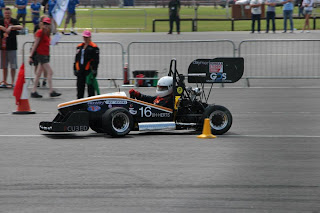

The UH16 on track.

Sadly, this wasn't to be for the UH Racing team as an electrical problem scuppered their run and they were unable to finish the event.  The passion the team have for their craft was tangible as the driver of the UH16 delayed climbing out of the car in an almost flat refusal to accept the situation.  Although a DNF in this event was a disappointing end for the team, they showed what strong competitors they are by winning three awards: The Mercedes AMG sponsored Best Powertrain Installation of an Internal Combustion Engine Award, UK and Ireland Measurement and Control Award and the award for the Most Effective Communications Strategy, which carries a valuable prize of a half day full scale wind tunnel testing, and a series of Aerobytes articles published in Racecar Engineering.


UH Racing has produced a car within the confines and the same vein of the original intention of Formula Student.  A competition started by four lecturers in the USA to provide students with the opportunity to learn and practice real workplace skills.  Since then it has grown globally and now includes five hundred teams. As with any competition, as it grows, it slightly changes with desire to win meaning boundaries are pushed regarding student involvement, resulting in some cars not looking like their own work.  The clue is in the name of the competition and in the time I spent talking to Howard Ash, it become clear that UH Racing is competing in the intended spirit with the following comment made by the Faculty Advisor encapsulating this,

“As a team I like to think we stick with the philosophy of the competition.”